 Eesti
Eesti English
 Русский
 Suomi
Suomi Latviešu
 Lietuvių
 Deutsch
 Polski
 Svenska
 Українська
VILFF · Knowledge base
VILFF for field surveys and interviews: how the app improves data collection and statistics
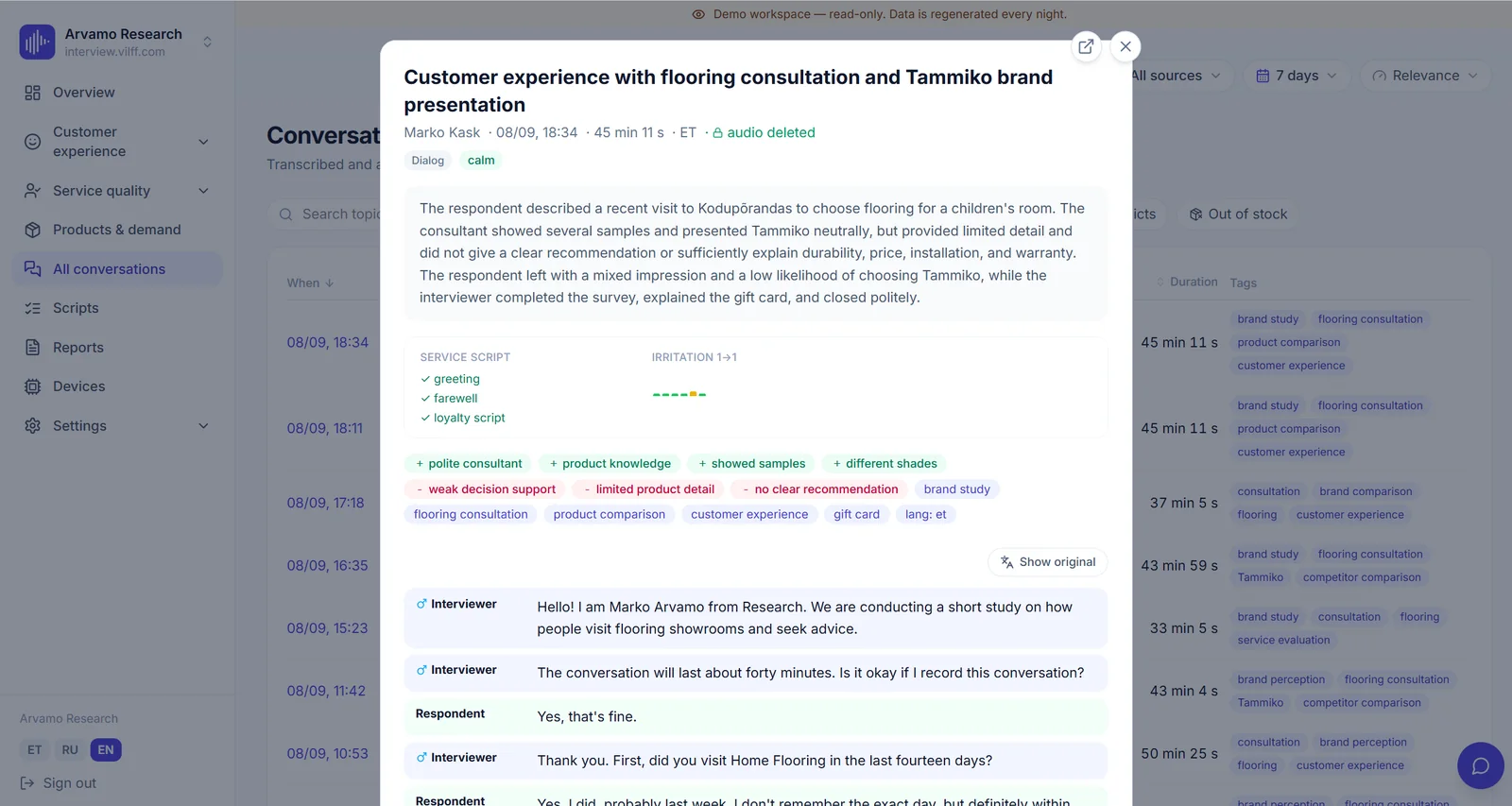
In a conventional field survey the interviewer conducts the conversation and records the answers at the same time, while the supervisor checks only a sample. With VILFF the interviewer simply talks: the app on the phone records the interview, the server converts it into text, AI completes the questionnaire for every conversation and backs each answer with a quote. As a result, the researcher receives 100% verifiable interviews, statistics for every question, an assessment of the interviewer's performance and a summary table ready for further processing - with no manual data entry.
Where data is lost in a conventional field survey
- Attention is divided. The interviewer listens to the respondent while selecting an answer option on a tablet or on paper. Part of what is said never reaches the questionnaire, and open-ended answers are cut down to two or three words;
- The answer is recorded as an interpretation. What enters the questionnaire is not what the respondent said but how the interviewer understood it. Open-ended questions are coded later, from memory;
- Quality control is sample-based. The supervisor listens to 5-10% of interviews, if recordings are made at all. Deviations from the script, leading questions and questions that were never asked go unnoticed in the remaining interviews;
- Statistics are compiled by hand. Questionnaires are transferred into a spreadsheet, and entry errors and discrepancies between interviewers surface at the analysis stage, when it is no longer possible to go back to the original source.
How a survey works with VILFF
- The questionnaire is uploaded to the portal. An Excel file is all it takes: AI turns it into a list of questions of four types - single choice, multiple choice, scale and open text. Questions can be edited in the interface, and every edit is saved as a new version;
- The interviewer installs the app. VILFF Recorder is installed from Google Play and linked to the project with a code in under a minute. Each interviewer is a separate source in the portal, and their recordings are never mixed with anyone else's;
- The interview is recorded in “Manual” mode. Recording runs continuously, in segments, and suits a conversation of any length. Without a network connection the app works offline and uploads the recordings once connectivity is restored;
- The server transcribes the conversation. Transcription works in any language, including mixed-language dialogue, and speech is separated by speaker. The audio is deleted after transcription, and the text is stored in encrypted form in the EU;
- AI completes the questionnaire. For every question the system provides an answer, a confidence level and a verbatim quote from the interview. Low-confidence answers are flagged for human review. Questions that cannot be answered from audio (the interviewer's observations, the appearance of the outlet) remain manual.
Request a demo or presentation
What improves in data collection
- The interviewer focuses on the respondent. There is no need to write during the conversation: the interview flows more naturally, the respondent says more, and follow-up questions are asked at the right moment;
- Answers are recorded verbatim. Open-ended questions yield the respondent's full wording rather than a paraphrase. For qualitative research the complete interview transcript is available;
- 100% quality control, not 5%. Every answer in the questionnaire is linked to a quote, and a single click opens the relevant passage of the transcript. It is clear whether the question was asked, in what wording, and whether the interviewer prompted the answer;
- No questionnaire without an interview. A completed questionnaire can only come from an actual recording, so the reliability of field data is settled at the level of the method itself;
- One standard for all interviewers. The questionnaire for every interview is completed by the same model under the same rules. The variance caused by interviewers interpreting questions differently disappears.
What improves in the statistics
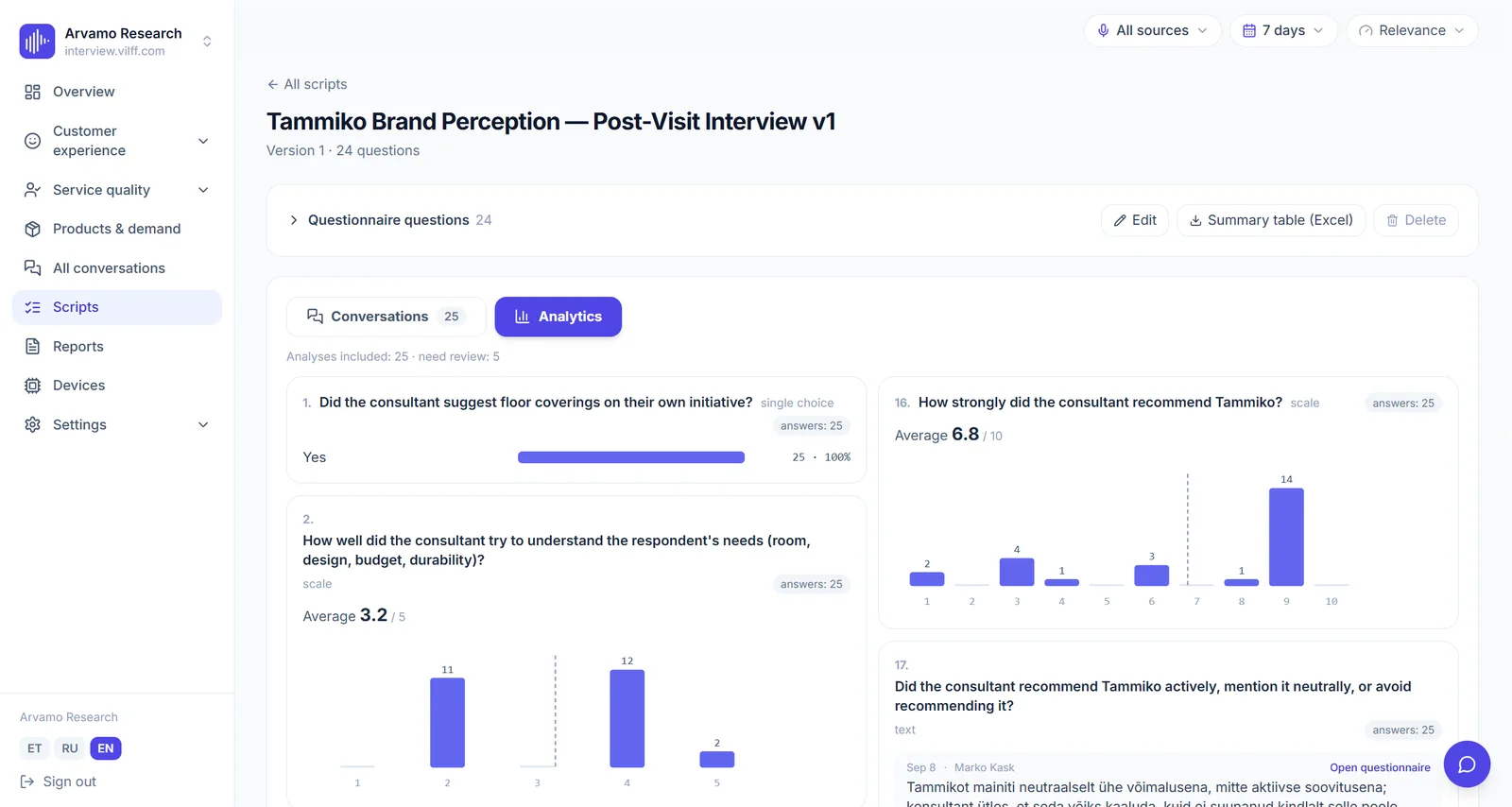
- Question-by-question breakdown straight after the interview. Choice questions show the distribution of answers, scale questions a histogram and mean, and open-ended questions a list of answers with links to the interview. Results are available the same day, not after the questionnaires have been keyed in;
- Breakdowns by interviewer and period. Statistics can be filtered by source (interviewer) and by date, so discrepancies between field staff are visible in the figures;
- Summary table in Excel. One click gives you a table with interviews as rows and questions as columns. It is ready to load into SPSS, Excel or a BI system without manual entry. The questionnaire for an individual interview can also be exported to Excel;
- Questionnaire versions are preserved. If the questions change during a wave, earlier interviews remain tied to their own version and are not mixed with new ones in the statistics.
Request a demo or presentation
The full VILFF analytics on top of the questionnaire
A questionnaire in Excel, an Android phone for every interviewer, and informing the respondent about the recording at the start of the conversation. No equipment or integrations are required. For research agencies the price is based not on the number of locations but on the volume of interviews processed - per minute of transcription: you pay only for what you record, and there is no cost between waves. We process the first 100 hours of interviews free of charge - enough for a pilot wave on your own questionnaire. The legal side of recording is covered in the article on the legality of recording conversations.
Interviews are recorded with the respondent's knowledge. The audio is deleted after transcription, and names and contact details in the text are replaced with placeholders.
Demo access or a video presentation
Leave your e-mail: we will send you access to the interview.vilff.com demo project with field interviews, questionnaires and statistics, and suggest a time for a 30-minute video presentation.
Thank you! We will write to the address provided with demo access and a suggested time for a call.
Sending failed. Please e-mail us at info@vilff.com
More answers
- Is it legal to record customer conversations in a store? (GDPR)
- Mystery shopping vs AI conversation analytics: which measures service quality better?
- What is in-store voice analytics and how does it work?
- How much does conversation analytics cost for a store, and what does it pay back?
- Can AI transcribe conversations where the customer and the clerk speak different languages?